

Tips on Safe Wasp Nest Removal
|
|
Wasps around the home are a serious health concern and so learning how to get rid of wasp nests safely is important if you do your own pest control.
It is important to correctly identify the type of wasp you are dealing with, as this determines the best wasp nest treatment.
European wasp nests
There are several types of paper wasp found in New Zealand, the most common species found around homes being the European wasps – the German wasp and the common wasp.
European wasps produce very different types of nests and build their nests in very different locations. Their aggressive nature coupled with the fact that their nests can grow into giant wasp nests of over 100,000 individuals, means that safety comes first when dealing with European wasp nests.
European wasps are also paper wasps and build their nest out of chewed up wood and plant material, much like Australian paper wasps. However, the structure of these nests is very different. Although the queen starts her nest is a similar fashion, building nest cells on a stalk, as the nest grows the wasps also build a shroud around the nest which eventually completely covers the nest, only leaving a single entry / exit hole at the bottom.
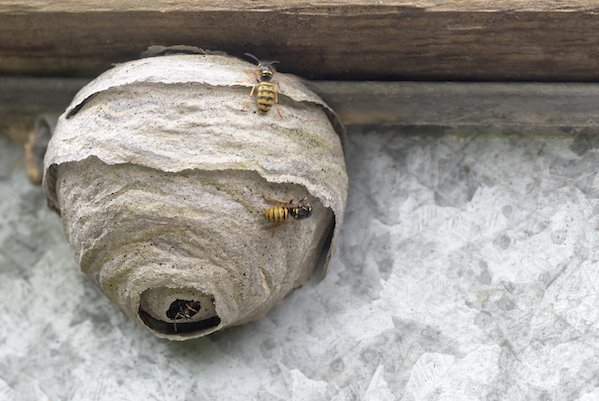
One of the important points to note about European wasps is that although they do build their nests on the outside of buildings, in roof voids and on trees, about 80% of nests are actually built in hollows underground!

Young above ground European wasp nests, before the outer shroud has been completed, can be dealt with in much the same way as Australian paper wasp nests – a direct blast with PestXpert Wasp Jet. For larger nests when the shroud is complete or when the nest is in the ground, getting the insecticide through the small entry / exit hole becomes problematic. In such situations it is recommended that you contact the local council or professional pest controller as specialised equipment will be required, to safely remove the nest.
Paper wasp nests
There are also the Asian paper wasp, Polistes chinensis, and Australian paper wasp, Polistes humilis. Although the Asian paper wasp looks superficially like the European wasps, it builds a similar nest to the Australian paper wasp.
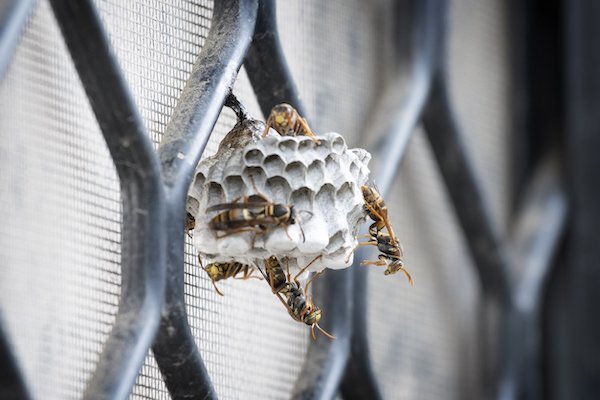
They make their papery nests by chewing up wood and plant material and mixing it with saliva. The Australian paper wasp builds its nest in sheltered positions, often under the eaves of homes or in the garden under branches or large leaves. The nest will often have a single point of attachment from which the nest hangs. The nest has an open structure so you can see the individual cells that contain the larvae, with the adult wasps resting on top. Most nests are only small with 20-30 individuals, although large nests can form with 100-200 wasps.
It is relatively easy to eliminate paper wasp nests. Considering the necessary safety precautions (see safety tips below), use PestXpert Wasp Jet to spray a stream of insecticide directly onto the nest. A one or two second burst should be enough to cover the nest and the wasps, which will be killed in seconds. Once the wasps have been killed, the nest can be removed by simply knocking it down with a broom and placed in the garbage bin (wear thick gloves).
Mud dauber and Potter wasp nests
Mud dauber and potter wasps build their nests out of mud. Mud wasp nests are easy to deal with as they are solitary wasps. Simply wait for the female wasp to get back to the nest and spray it with insecticide. The mud wasp nest itself can be knocked down with a broom and any larva can be physically destroyed.

How to stop wasp nests being built?
Spraying areas with a residual insecticide can be very effective at preventing wasps building nests. PestXpert Pro-Spray Outdoor Perimeter is a great option, preventing wasps building their nests for many months. Application may be necessary once or twice a year. After a wasp nest has been removed, it is also advisable to treat the area with a residual insecticide as other wasps are likely to be attracted to the same area.
Important safety tips:
Firstly, follow all instructions on the product label, especially any instructions around its use in electrical areas. Note: PestXpert Wasp Jet has a special low conductivity formulation to reduce risks around electrical equipment.
- For protection against stings, make sure, thick long-sleeved shirts and trousers (or overalls are worn), along with sealed shoes and thick gloves.
- For European wasps, also make sure all joins between clothing and gloves / shoes are sealed with tape.
- A bee net is strongly recommended for all wasp treatments.
- Don’t stand on a ladder to treat a wasp nest.
- Ensure you have an escape path clear of obstructions to use after treatment if necessary.
- Spray the nest at night when the wasps are back in the nest and generally more docile.
- If you need to use a torch, make sure it has a red filter (insects cannot see red light).
More information on wasps.
PestXpert Products for Wasp Nest Control


Author:
Gordon Reidy has over 30 years experience in Pest Control Product Development and Product Safety. As the lead formulator at PestXpert, he has helped develop some of Australia’s most trusted household pest solutions. With a PhD in Toxicology, Gordon is passionate about delivering effective, science-backed products that are safe for families and the environment.
Share This Post
Further Reading
-
 The PestXpert Guide to Wasp Control
Wasps are a big problem in New Zealand. Learn about the key pest wasps and how to control them.