
How to Control Cockroaches
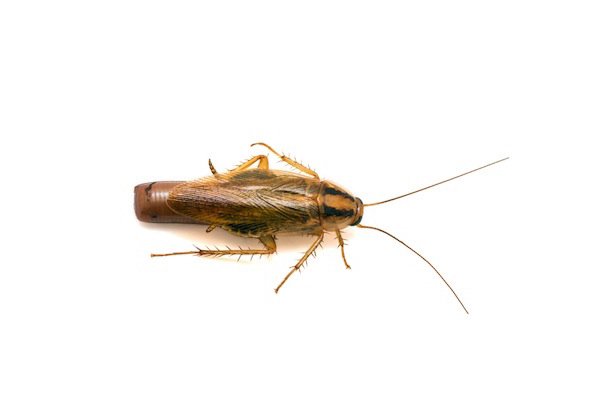
Cockroaches are probably the most unwanted pest in the home. Their connection with filth and quick scurrying movements certainly create a lot of anxiety. For some, the appearance of just one cockroach can make them feel as if they are a bad housekeeper (although often it is not their fault).
Fortunately with a combination of good prevention tips and suitable pest control products, most cockroach problems are easy to control.If you want to know a bit more about cockroaches – types of cockroaches, the cockroach life cycle and other interesting facts, read one…
Cockroach Identification
Types of Cockroaches
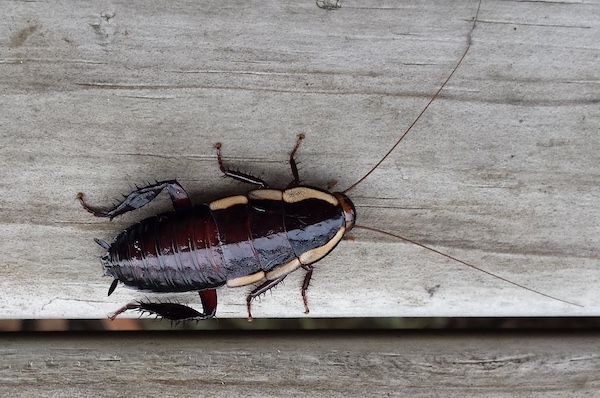
There are over 4500 species of cockroach globally, but only around 30 of them are considered as pests. Here in Australia there are 6 common pest cockroaches.
Pest cockroach species
Generally speaking the pest cockroaches can be broken down into “large cockroaches” and “small cockroaches”.
Large cockroaches


Small cockroaches


Back to Cockroach Menu
Key Cockroach Facts
- Cockroaches will eat virtually anything, even each other!
- German cockroaches do not stray far from their hiding places – adults only travel 1-2 m from their harborage. The young cockroaches do not leave their hiding place at all, eating the vomit and faeces of other cockroaches to survive!
- The American cockroach has been measure running at a speed of 5.4 km/h, which would be comparable to a human running at 330 km/h.
- Cockroaches are thigmotactic which means they like confined spaces. It also explains why the tend to run around the perimeter of rooms (so they can feel the wall).
- Although many adult cockroaches have wings, most species do not fly. Adult American and Australian cockroaches will fly, but only in warmer weather.
- The names of the pest cockroaches German, American, Australian don’t really describe where they come from, as they are found in many countries. For example in Germany, the “German” cockroach is sometimes called the “Russian” cockroach!
COCKROACH DISEASES:
Given the places that cockroaches hide, including the sewer, drains and in the garbage, it is perhaps not surprising they are viewed as “dirty” animals. Indeed, cockroaches carry a range of diseases, including Salmonella, dysentery and polio, as well as a number of other bacteria that give rise to stomach upsets.
However, it is the shed cockroach skins and droppings that cause the biggest problem, as they contain allergens. In cockroach infestations these can give rise to allergic reactions and asthma – cockroach infestations are probably the highest cause of asthma in many inner city apartment blocks.

Life-cycle of a Cockroach
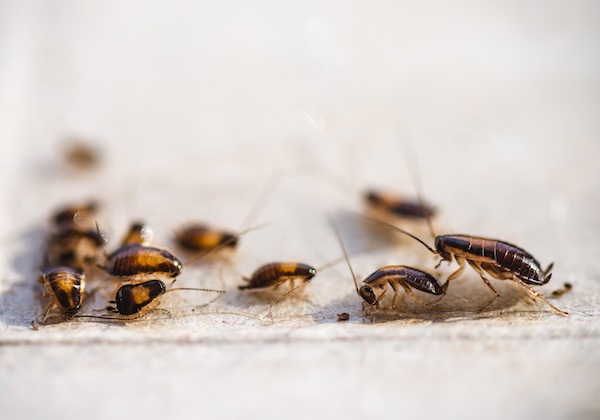
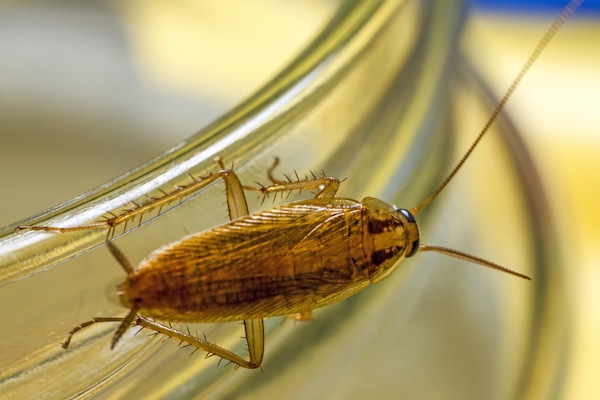
Cockroaches are a primitive insect. Cockroaches hatch from eggs into nymphs (young cockroaches) and go through several stages before becoming an adult. As the cockroach nymphs are similar to the adults (just smaller and lacking in wings), this process is called incomplete metamorphosis. This is unlike the transformation of a caterpillar into a butterfly which is a complete metamorphosis (complete change in body form).
The length of the life-cycle depends on the species (generally larger species have a longer life-cycle) and the temperature (higher temperatures mean a faster life-cycle). The life-cycle but can vary from between 3 months and 2 years.
Cockroach eggs
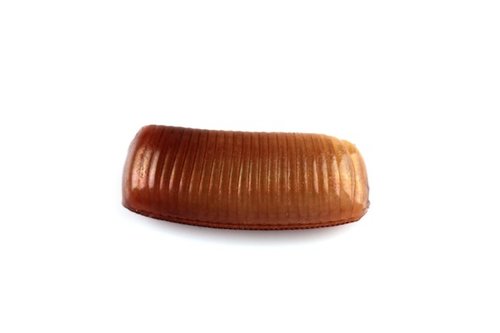
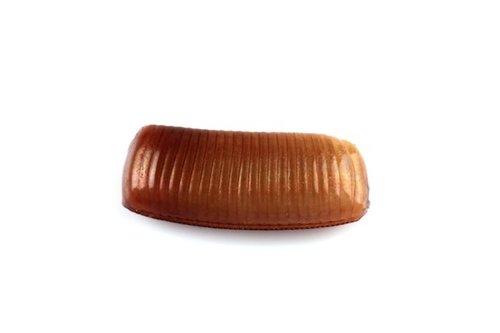
Cockroaches don’t lay eggs but have egg cases. These egg cases can contain between 16 and 40 eggs, depending on the species – smaller species have more eggs. The eggs develop into nymphs inside the egg cases and emerge as live young. Some cockroach species, such as the German cockroach carry the egg case until just before hatching, others such as the American cockroach place their egg cases near a food source for later hatching.
Egg cases in cardboard boxes are a common way cockroach population get started in homes!
Baby cockroaches
White cockroaches
Flying cockroaches
Back to Cockroach Menu
Signs of a Cockroach Infestation
Cockroach droppings
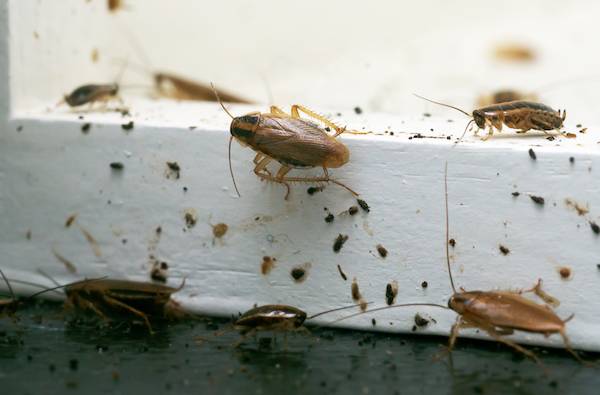
Cockroach droppings are obviously gross, but if you know what you’re looking for, they can be a sign you have a cockroach problem.
Large cockroaches produce more obvious droppings, more like a small pellet, whereas German cockroaches produce droppings which are more like spot, often with some liquid. When there are a large number of spots in one location, it indicates you have a major infestation on your hands!
Cockroach droppings are a major source of allergens that can cause asthma.
Back to Cockroach Menu
Cockroach Prevention Tips
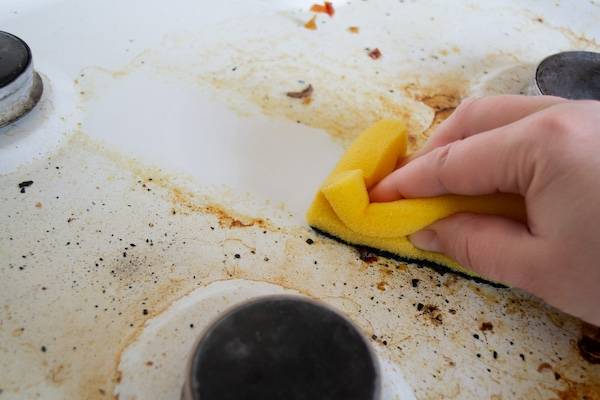
Good Hygiene Is Critical:
Back to Cockroach Menu
Cockroach Control Tips

Cockroach Products
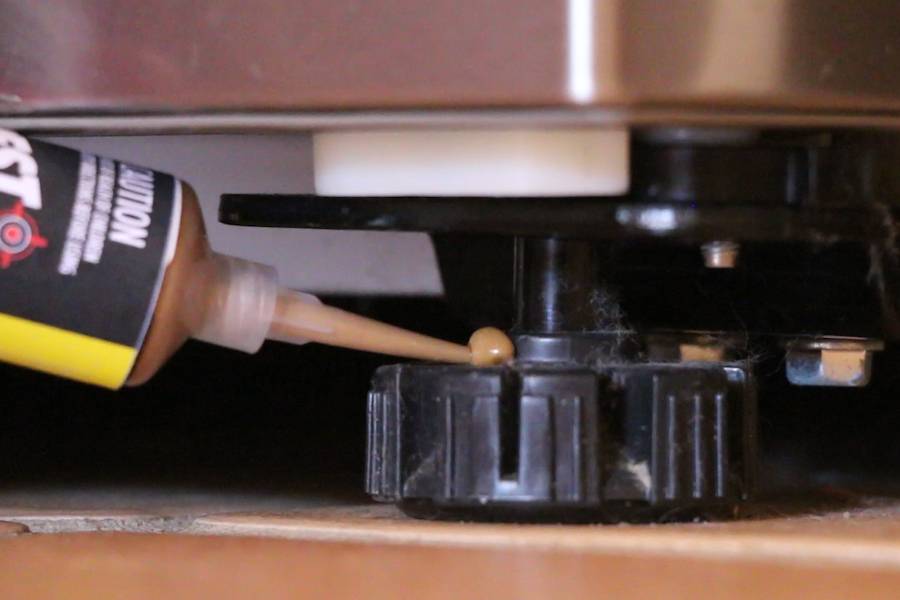
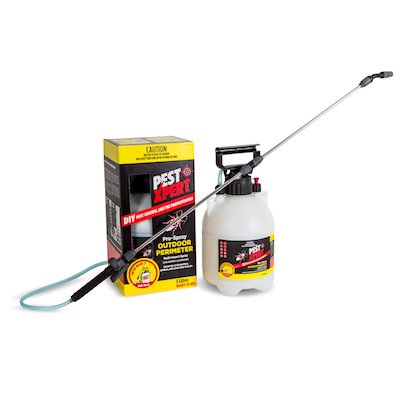
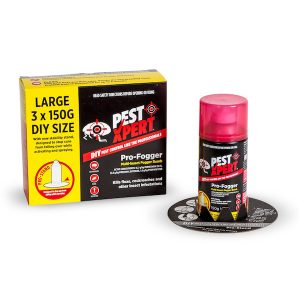
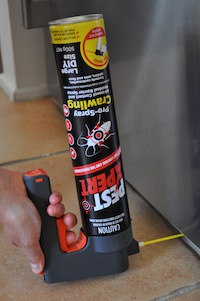
A range of products are available to control cockroaches. Whereas a cockroach spray inside and outside the home may be good for large cockroaches, for small cockroaches (German cockroaches) and cockroach infestations, it is often necessary to use a number of different products in combination.
Which Products to Apply When?
Back to Cockroach Menu
PestXpert Products For Cockroaches


Back to Cockroach Menu
FAQs about Cockroach Control
Back to Cockroach Menu
PestXpert Blog
For the dedicated PestXperts…
The PestXpert Blog gets updated regularly with articles on pests, products and tricks of the trade.
Take your pest control knowledge to the next level and say goodbye to pest problems.
-
 Cockroach sprays – How do they work?
We’ve all seen the ads – the homeowner sprays the perimeter of the room with an insecticide spray, a cockroach (of the computer animated variety) approaches the treated area and zap – the cockroach is killed by an invisible force…
-
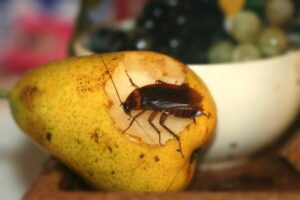 Cockroach infestation? Use a cockroach bomb!
If you have a persistent cockroach problem or maybe a cockroach infestation, you need to pull out the “big guns” and a cockroach “bomb” is just the ticket!Insecticide “bombs” or “foggers” are technically known as “total release aerosols” – once…
-
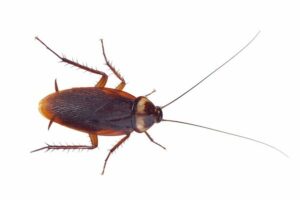 How to get rid of large cockroaches
Large cockroaches certainly have a big “eek” factor. Their large size, fast scurrying movements and ability to fly are all too much for some people. The good news is that if you have a problem with large cockroaches, they are…